Denis Zavadski
Denis Zavadski

Denis Zavadski

PhD candidate · Computer Vision and Learning Lab · Heidelberg University

I work on generative image and video models. My research focuses on how to control them, how to make them cheaper to train and run, and how to use them to generate useful training data.

My PhD is supervised by Carsten Rother and Stefan Roth and funded by a scholarship from the Konrad Zuse School of Excellence in Learning and Intelligent Systems (ELIZA). Since January 2026, I have also been a visiting researcher in Stefan's group at TU Darmstadt.

From March to September 2026, I was an ML Research Intern in Vladlen Koltun's group at Apple in Zurich, where I worked on large-scale text-to-image and text-to-video diffusion and flow models, with a particular focus on video editing.

InterestsDiffusion & flow models · Controllable generation · Efficient large-scale models · Representation learning · Synthetic data
News

Papers

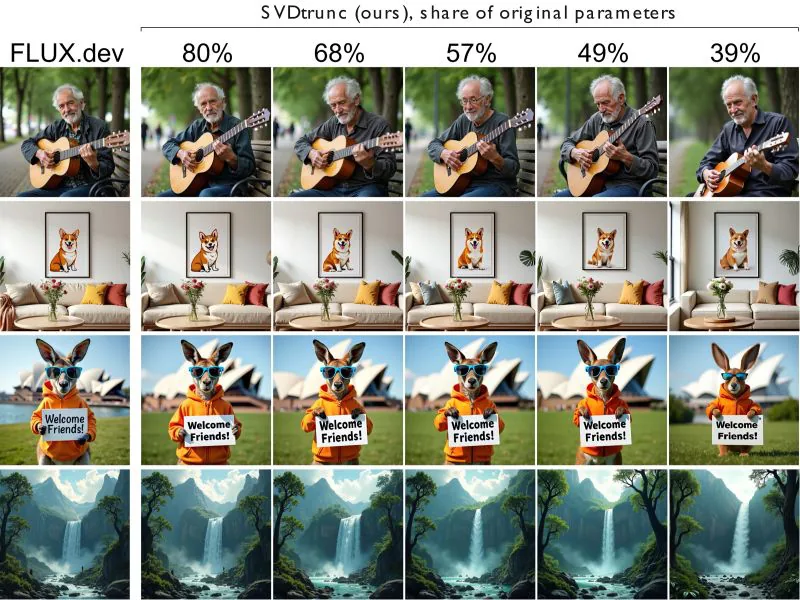
FLUX.dev samples next to SVDtrunc-compressed models at 80% to 39% of the parameters

ECCV 2026

Importance-Aware Low-Rank Distillation of Diffusion Transformers

Denis Zavadski, Sebastian Heid, Damjan Kalšan, Stefan Roth, Carsten Rother

Compresses diffusion transformers such as FLUX by assigning ranks per block according to importance, truncating the least important blocks with SVD, and recovering quality through distillation. It keeps near-full quality at about 68% of the parameters.

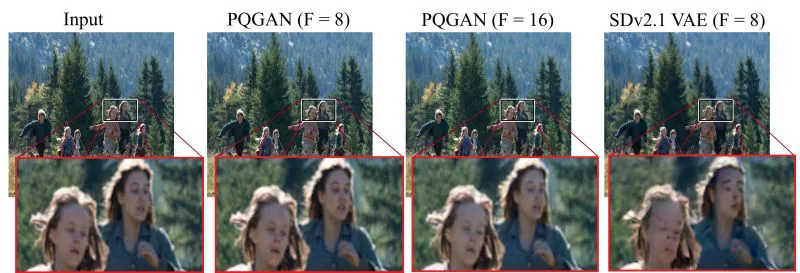
Reconstructions of PQGAN compared with the Stable Diffusion 2.1 VAE

ICLR 2026

Product-Quantised Image Representation for High-Quality Image Synthesis

Denis Zavadski, Nikita Philip Tatsch, Carsten Rother

PQGAN brings product quantisation into the VQGAN framework, giving image autoencoders higher reconstruction quality for downstream image synthesis.

3DV 2026

Online Video Depth Anything: Temporally-Consistent Depth Prediction with Low Memory Consumption

Johann-Friedrich Feiden, Tim Küchler, Denis Zavadski, Bogdan Savchynskyy, Carsten Rother

An online version of Video Depth Anything that borrows caching and frame masking from LLMs. It runs at 42 FPS on an A100 and 20 FPS on a Jetson.

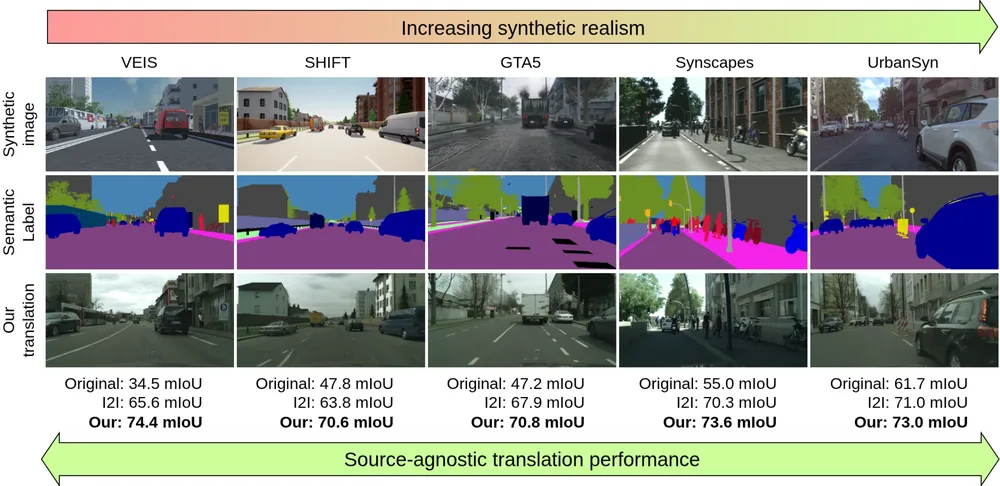
Synthetic urban images translated to the Cityscapes domain, with segmentation scores

ICPR 2026 Oral

A Framework for Low-Effort Training Data Generation for Urban Semantic Segmentation

Damjan Kalšan*, Denis Zavadski*, Tim Küchler, Haebom Lee, Stefan Roth, Carsten Rother · *equal contribution

Adapts an off-the-shelf diffusion model to a target domain using only imperfect pseudo-labels, then generates aligned training images from semantic maps. It gains up to 8.0 mIoU points over prior translation methods.

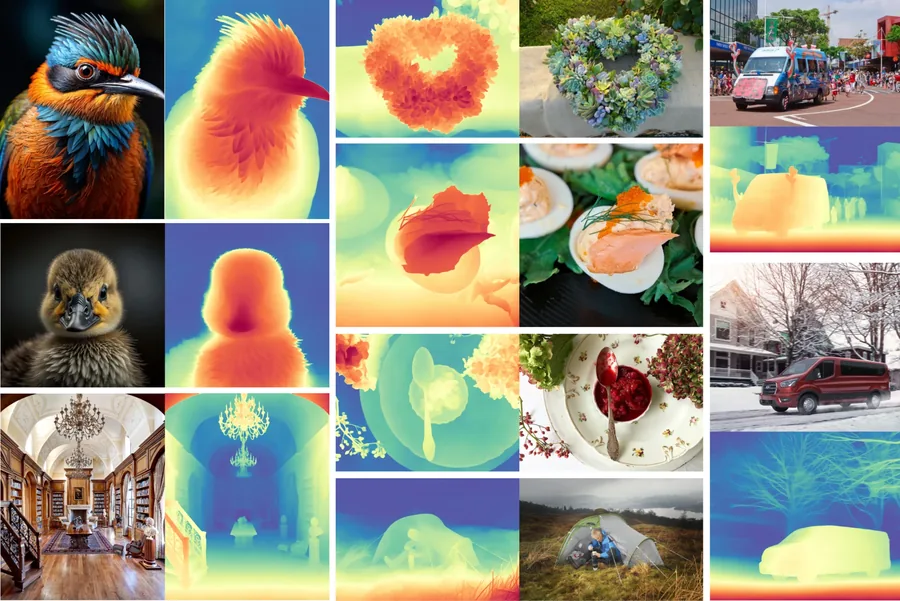
Images and their PrimeDepth depth maps

ACCV 2024

PrimeDepth: Efficient Monocular Depth Estimation with a Stable Diffusion Preimage

Denis Zavadski, Damjan Kalšan, Carsten Rother

Uses a single-step Stable Diffusion "preimage" as a rich feature representation for fast, accurate monocular depth estimation.

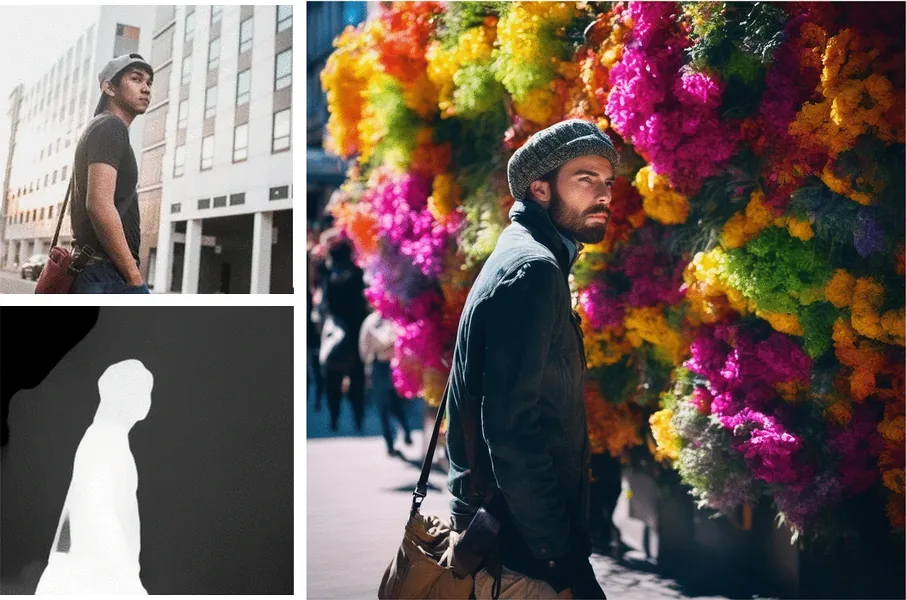
A photo, its depth map, and an image generated with ControlNet-XS from that depth map

ECCV 2024 Oral

ControlNet-XS: Rethinking the Control of Text-to-Image Diffusion Models as Feedback-Control Systems

Denis Zavadski, Johann-Friedrich Feiden, Carsten Rother

Treats image control as a feedback-control problem, with information flowing both ways between the control network and the base model. The control network can be as small as 1% of the base model's parameters.

Experience

Research

  • Jan 2026 – now

    Visiting PhD Candidate

    Visual Inference Lab, TU Darmstadt · Host: Stefan Roth

  • Mar – Sep 2026

    ML Research Intern

    Apple, Zurich · Group of Vladlen Koltun

    Research on large-scale text-to-image and text-to-video diffusion and flow models. Co-started a video-editing project and built its first data and training pipeline. When it grew into a larger team effort, I co-led it.

  • 2020 – 2022

    Student Assistant

    CompVis Group, Heidelberg University

    Implemented deep learning methods for an industry collaboration on autonomous driving.

Education

  • 2023 – now

    PhD, Computer Science

    Heidelberg University

    Efficient and controllable data synthesis, quality assessment of synthetic data. Funded by an ELIZA PhD scholarship.

  • 2020 – 2022

    M.Sc. Data and Computer Science

    Heidelberg University

    Thesis: Continuous arbitrary-scale image synthesis with patch-wise diffusion models (Prof. Björn Ommer)

  • 2017 – 2020

    B.Sc. Applied Computer Science

    Heidelberg University

    Thesis: Nonparametric prediction of plausible object motion (Prof. Björn Ommer)

Teaching

  • 2023 – 2025

    Co-supervision, Computer Vision lecture

    Heidelberg University

  • 2024

    Teaching Assistant, Intelligent Systems lecture

    Heidelberg University

  • 2023 – 2026

    Master's thesis co-supervision

    Four theses on generative modelling, model efficiency, synthetic data and generative-model evaluation